显示标签为“
Historical sites”的博文。
显示所有博文
显示标签为“
Historical sites”的博文。
显示所有博文
Masjid Zahir to get 100th year makeover
THE iconic Masjid Zahir, listed as one of the 10 most beautiful mosques in the world, will undergo beautification works for its 100th anniversary next year.
The state government has allocated RM2.2 million for the upgrading and beautification works of the mosque, which was designed by the architect who also designed the Azizi Mosque in Langkat, north Sumatra, Indonesia.
With five large domes to symbolise the five pillars of Islam, it was built in 1912 during the reign of Sultan Muhammad Jiwa Zainal Abidin II.
An elegant example of Malay-Islamic architecture, Masjid Zahir is one of Kedah’s most distinctive architectural landmarks.
The mosque occupies a site of approximately 11,558 sq m.
Its prayer hall is surrounded by verandahs with four mezzanine areas. Each mezzanine area is roofed by a dome.
It was officially opened on Oct 15, 1915, by Sultan Abdul Hamid Shah.
State Tourism, Indian and Siamese Community Affairs Committee chairman Datuk Mohd Rawi Abdul Hamid said works would start early next year.
The project includes improving the toilets, place for ablutions, and landscape.
A monument will be built in remembrance of warriors who died while defending the state during the Kedah-Siam War in 1812.
“We are not only beautifying the mosque for its 100th anniversary but also improving its facilities to receive more tourists,” he said.
Rawi said the monument would be build in the mosque’s compound in honour of the some 1,000 heroes buried on the mosque site, who died defending the state from Siamese invasion.
He said the state government, with the cooperation of the state Islamic Department, was planning programmes for Masjid Zahir’s 100th anniversary celebration.
“We hope these programmes will help to boost the number of visitors, both local and foreigners, to the Alor Star landmark.”
Visitor Izamudin Jusoh, 25, lauded the move to beautify and upgrade Masjid Zahir.
“It is time to give the mosque a new look as it enters its 100th year. The mosque is one of the most attractive buildings in the state and it is important for the state government to keep it well maintained,” he said.
Atikah Che Nasir, 32, from Ipoh, said it was a good idea to renovate the mosque.
“This is one of the most beautiful mosques in the country and I hope that the renovation and upgrading works will keep its unique identity,” she said.
 An elegant example of Malay-Islamic architecture, Masjid Zahir is one of Kedah’s most distinctive architectural landmarks.
~News courtesy of New Straits Times~
Turn war bunkers into attractions
The Historical Society of Malaysia says WW2 bunkers in Kedah can become tourist attractions
The Historical Society of Malaysia is urging the state government to initiate a programme to rehabilitate and turn World War 2 bunkers into heritage tourism attractions.
Its Kedah chapter chairman Datuk Wan Shamsudin Mohd Yusof said the association had identified 26 bunkers in Alor Star, Bukit Pinang and Sungai Petani which had the potential to be turned into historical sites.
He said the bunkers had become an eyesore and some had been turned into dumping sites or become breeding grounds for mosquitoes and poisonous reptiles.
"The WW2 bunkers have precious historical value.
"We hope the state government will take the initiative to rehabilitate the structures and turn them into tourist attractions," he said.
Wan Shamsudin said the association was worried that the bunkers would be eroded in time and forgotten by the public.
One of the villagers of Hutan Kampung, Firdaus Othman, 18, said the bunkers had potential to become tourism products for the state.
He said, about two months ago, a group of tourist from Europe had visited the bunkers in the area.
"It is a waste if we do not value these historical structures," he added.
State Tourism, Energy, Indian and Siamese Affairs and Islamic Religious Committee chairman Mohd Rawi Abd Hamid said a plan to rehabilitate and conserve the bunkers was already in the pipeline.
He said work to rehabilitate the bunkers would be starting soon and they would be turned into tourism products.
"Besides the war bunkers, we have also identified other structures that have the potential to be turned into heritage tourism attractions such as old houses and buildings which have national historical value," added Rawi.

Firdaus Othman (right) said European tourists visited WW2 bunkers in Hutan Kampung about two months ago.
~News courtesy of New Straits Times~
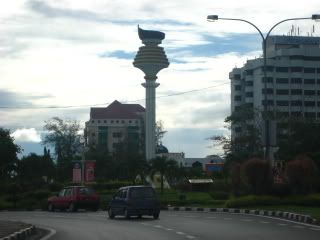
 Perlis Kangar's Landmark - 玻璃市加央地标交通圈
Ancient sites unearthed
BUJANG Valley in Merbok, Kedah, is twice bigger than what was originally thought, according to new findings by a team of researchers from Universiti Sains Malaysia (USM).
Team leader Assoc Prof Dr Mokhtar Saidin said following the discovery of ancient furnaces for iron smelting two weeks ago in Jeniang, the size was now estimated to be 35km in radius compared to 15km in radius before.
“This mean the Bujang Valley civilisation area encompasses about 1,000sq km compared to 400sq km before,” he told a press conference in Penang yesterday.
He said the southern area of the civilisation still stretched from Merbok to Bukit Mertajam but the eastern side, previously believed to end at the North-South Highway, now stretched till Jeniang.
Mokhtar said a team of eight researchers from the Centre for Global Archaeological Research found the furnaces in Jeniang, which is about 30km from Bujang Valley.
He said the team, which conducted excavations from February 2009 to May this year, found complexes such as ritual sites and industries of early civilisation in Bujang Valley which was based on the iron industry.
“We excavated 10 sites along Sungai Batu in Bujang Valley and found evidences that furnaces were used by the ancient civilisation,” he said.
Based on dating samples of iron smelting sites, he said an early civilisation which was probably based on animism existed there between the first and fifth century.
But from the fifth century to the 14th century, the area was a thriving Hindu and Buddhist civilisation, he added.
It had been reported that archaeologists had unearthed temple ruins and artefacts dating back to more than 1,500 years there.
In a related matter, Mokhtar said an international conference on ‘Bujang Valley and Early Civilisations’ in South-East Asia would be held at Royale Chulan Hotel in Kuala Lumpur from Monday to Wednesday.
It is organised by the centre and the Department of National Heritage of Malaysia.
He said 28 academic papers would be presented by archaeologists from South-East Asian countries as well as from China, India, United States and Britain.
-News courtesy of The Star-